Showing posts with label philosophy. Show all posts

03 May 2014

because they have always already occurred

the present is always already a state of anticipation.

"so, how is it that things happen? aren't we always just waiting for the--"

because they have always already occurred.

20 March 2013

The Unknown


The Unknown from Lucas Ankney on Vimeo.

Please enjoy The Unknown, a visually-arresting, meditative journey by graduating student, Lucas Ankney. His work is in the vein of Jodorowsky, Derek Jarman, and Matthew Barney.

27 January 2013

Chuang Tzŭ and King James: Scriptural Smackdown or Textual Tag-Team?

In reading Chuang Tzŭ, I ran across several passages that brought to mind specific verses from the Bible. These are some of the points of comparative doctrine that emerged.
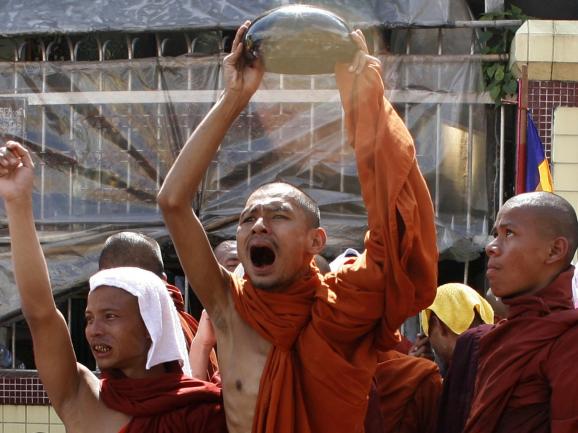
Photo: Reuters

AN EMPTY VESSEL

2 Timothy 2:20-21 (King James Version)

20 But in a great house there are not only vessels of gold and of silver, but also of wood and of earth; and some to honour, and some to dishonour.
21 If a man therefore purge himself from these, he shall be a vessel unto honour, sanctified, and meet for the master's use, prepared unto every good work.

Chuang Tzŭ, Chapter 4: "The Human World," p.80 (Fung Yu-Lan, Translator)

The function of the ear ends with hearing; that of the mind, with symbols or ideas. But the spirit is an emptiness ready to receive all things. Tao abides in the emptiness; the emptiness is the fast of mind.


BE AS CHILDREN

Matthew 18:3-5 (King James Version)

3 And said, Verily I say unto you, Except ye be converted, and become as little children, ye shall not enter into the kingdom of heaven.
4 Whosoever therefore shall humble himself as this little child, the same is greatest in the kingdom of heaven.
5 And whoso shall receive one such little child in my name receiveth me.

Chuang Tzŭ, Chapter 4: "The Human World," p.86 (Fung Yu-Lan, Translator)

If the son of the prince should act as if he were a child, you also should act as if you were a child. If he should cast aside all differences, you should do the same. If he should cast aside all distinctions, you also should do the same. Then you can lead him to innocence.


KNOWLEDGE, DISTINCTION, JUDGMENT

Genesis 2:18-9 (King James Version)

18 And the LORD God said, It is not good that the man should be alone; I will make him an help meet for him.
19 And out of the ground the LORD God formed every beast of the field, and every fowl of the air; and brought them unto Adam to see what he would call them: and whatsoever Adam called every living creature, that was the name thereof.

Genesis 3:3-7 (King James Version)

3 But of the fruit of the tree which is in the midst of the garden, God hath said, Ye shall not eat of it, neither shall ye touch it, lest ye die.
4 And the serpent said unto the woman, Ye shall not surely die:
5 For God doth know that in the day ye eat thereof, then your eyes shall be opened, and ye shall be as gods, knowing good and evil.
6 And when the woman saw that the tree was good for food, and that it was pleasant to the eyes, and a tree to be desired to make one wise, she took of the fruit thereof, and did eat, and gave also unto her husband with her; and he did eat.
7 And the eyes of them both were opened, and they knew that they were naked; and they sewed fig leaves together, and made themselves aprons.

Chuang Tzŭ, Chapter 2: "The Equality of Things and Opinions," p.53 (Fung Yu-Lan, Translator)

The knowledge of the ancients was perfect. How perfect? At first, they did not yet know that there were things. This is the most perfect knowledge; nothing can be added. Next, they knew that there were things, but did not yet make distinctions between them. Next they made distinctions between them, but they did not yet pass judgments upon them. When judgments were passed, Tao was destroyed. With the destruction of Tao, individual preferences came into being.

30 December 2012

When wegos collide - 13 November 2007

Buddhist priests of the Big Asakusa Temple prepare for the Second Sino-Japanese War as they wear gas masks during training against future aerial attacks in Tokyo, Japan, on May 30, 1936. (AP Photo)

            Every war is a civil war.  We construct an illusory distance between ourselves and whomever we deem to be the enemy of the moment, polarizing them on the side of evil and us on the side of good.  President George W. Bush’s familiar rhetoric of the “axis of evil” used to incite and maintain the current state of war is an overt example of this distancing technique.  In truth, however, when we engage in any war, there are no clear-cut lines of good and evil; when we battle our “enemies,” we battle our friends and neighbors, our sisters and brothers.  Political, social, and economic allegiances are in a constant state of flux; we have all been allies at some point and will be reborn again as allies as our needs and attitudes shift over time.  In the meantime, we rend the very fabric of people’s lives in search of a victory that can never come.  No matter who wins the battle, we all lose when we fight in service of the monumental deception of selfhood.
The geopolitical borders of the nation-state are not physical walls built to keep our enemies out, but are manufactured conventions, no less fortified, which keep our fragile selves within.  The nation is not a physical reality but instead a conceptual construct we use to maintain the fallacy that we are separate from and superior to the other communities around us.  This convention is a projection of our collective egos, or our wego, as referred to by David R. Loy in his book, The Great Awakening.  Loy posits that just as we individually create and preserve a notion of self, we collectively create and maintain similar group “selves.”  This self-identification is inextricably bound up in the dualistic thinking we utilize in an attempt to stabilize an unstable existence.  Ironically, the very tool with which we are attempting to steady our world is one of the main causes of instability and conflict.  Dualistic thinking is one of the delusions that propagates war.
Peter Harvey, in An Introduction to Buddhist Ethics, cites delusion such as this along with anger and greed as the root causes of war.  These three seeds of unwholesome individual action are writ large on an international scale when our collective wegos engage in them.  Just as the individual can overcome these poisons by cultivating their opposites (wisdom, compassion, and generosity), so too can nations.  This is the Buddhist solution to war.  In practical terms, though, what does this mean and how can we apply it to contemporary global conflict?
Increasingly, I believe that justice may be, ironically, a hindrance to peace.  That is to say that our conception of “justice,” more akin to retribution, is a source of conflict.  In our democratic society, if an individual is wronged, that individual or the individual’s loved ones seek justice.  If property damages are involved, people seek to recoup at least the monetary amount of the damages and the costs of legal proceedings.  Many murder victims’ families seek the death penalty for those charged with the slaying of their loved ones.  We have an “eye for an eye” notion of justice.  On an international scale, we think in similar terms.  If we as a nation are attacked, our sense of justice will not be satiated until we strike back.  Justice, for us, is reactive, vengeful, and delusive. 
Although Buddhism generally does not discuss justice, we can apply Buddhist thinking to the concept to shift it from this harmful notion focused on consequences to a proactive, beneficial one focused on motivations.  What are the causes of our current conflicts?  What ill-will, greed, and delusion are we engaging in that may have led to conflict?  How are we responsible, even when we don’t want to admit any responsibility?  Instead of striking out, we may be able to avert conflict by looking inward.
If, instead, we do take aggressive action, we are submitting to another delusion—that we can alleviate our own suffering by causing others to suffer.  This idea is one which surfaces time and again in Harvey’s discussion of topics like euthanasia and abortion.  This fundamental delusion seems to inform much of our decision-making concerning ethical issues.  In our often-impassioned attempts to serve justice, we instead create a sustained cycle of suffering.  When we act to satisfy our need for justice, there is always the possibility that another group will view those actions as threatening to their wego and act, in turn, to satisfy their own need for justice.  This sounds very much like the perpetual revolution of the wheel of samsara. 
How are we to break such a cycle?  As individuals, in order to escape from the wheel of suffering, we must awaken.  With clear vision, we can see through the delusion and we can elect not to participate in our unjust system of justice.  That is not the same as “turning the other cheek” when we are wronged.  Instead, we should seek resolution over retribution, eliminate the causes of others’ suffering and we eliminate the causes of our own.  This is true justice, though it may sound like the converse of our current skewed concept of justice.  It may be bittersweet as we are forced to recognize our own responsibility, or at least our own complicity, in the processes that create conflict.  If we can make this kind of change on a personal level, we can then effect change on the institutional, national, and global levels.
At the most basic level, this is just another call to give up our illusory sense of self and to stop acting in ways to protect that delusion at the expense of others.  This sounds more difficult than it really should be because our society has been built around the glorification of the individual; we are taught from an early age just how to maintain the sense of self.  Even our most conformist of institutions, the military, recruits with slogans like “be all that you can be” and “army of one,” again glorifying the individual while simultaneously conditioning soldiers to sacrifice that individuality for the larger wego.  We must indeed sacrifice our selves, but not to be replaced by larger, institutional bodies which would lead to a totalitarian state.  We must sacrifice our selves for one another, regardless of nationality or other superficial differences like gender, skin color, sexual orientation, religion, or political beliefs.  Sacrificing our selves need not mean sacrificing our lives or the lives of others, just sacrificing our misperceptions.
Thich Nhat Hanh’s description of our fundamental relationship with all things is “interbeing.”  This is more than a series of cause and effect relationships or links in a chain of being, but an inextricable interpermeation of all beings, each dependent upon all others.  In order to successfully coexist with one another, we must awaken to the understanding of this concept.  Just as our individual egos collectively form ever-radiating circles of wego based on our self-identification with various groups like families, states, and nations, we have to recognize the multiple layers of the web of interbeing affecting those groups.  Our beliefs and actions cannot be separated from those of other individuals, families, states, and nations, again each dependent upon all others.  When we strike others, we strike ourselves.  When we save others, we save ourselves.  We will never alleviate suffering by causing more suffering, we will never achieve justice through retribution, and we will never achieve peace through violence.

28 December 2012

Toppling the Tower of Self-Gratifying Economics


Like Rapunzel, I am kept alienated from others in the topmost chamber of a lofty tower, so high above the ground that I can see neither the tower’s foundations nor its exit.  Just like the heroine of that tale, I let down my proverbial hair to admit my heart’s desires, whatever those might be at the moment, in hopes that one will finally free me. My hair is always down, netting more and more pleasures and hoisting them up for my own greedy, isolated consumption in my misdirected search for liberation. Unlike the princess of the classic fable, I have erected this tower myself and I am both prisoner and warden within it.  An even more apt description would be to say that I am the tower itself: an edifice of ego built to protect an ever-craving fragile sense of self.  The tower and the system of acquisition and consumption I have constructed allow me to enjoy virtually limitless pleasures without being bothered by the “hows” and “whoms” of those pleasures’ manufacture.  My sense of identity is inextricably bound up with the consumer capitalist system in which I am complicit; my tower is built upon the backs of working women and men.

* * *
It may seem quite a reach to begin a theory of Buddhist economics with a Western fairy tale; however, as Western Buddhism emerges and develops in contemporary consumer capitalist economies, it becomes apparent that this ancient way can flourish today by appropriating familiar elements of those cultures.  Just as historically Buddhism has been able to adapt and spread through some degree of syncretism with already-inculcated belief systems across Asia, its chances for survival today in the West may depend on its ability to infiltrate existing religious, social, political, and economic institutions.  For many people in this predominately Christian society, Buddhism appears to be a mystical and exotic religion, foreign and esoteric without any relevance to the contemporary West.  If the majority was to start taking it seriously as a viable alternative, not just to Christian thought but also to capitalist thought, it suddenly becomes a foreign threat, a seemingly open attack on our values and the foundations of our society.
Buddhism, however, is not just a religion or philosophy, but a practical path for living, and it is this facet of Buddhism that may be most appealing to the pragmatic West.  A Buddhism that does not openly conflict with Christianity, a “safe Buddhism” with the aura of psychology or self-help that might augment our current systems is one that could easily be accepted in the West and incorporated into our existing traditions. The danger, I fear, in this subtle approach is that the bottomless pit of our consumer capitalist economy will swallow up such a “safe Buddhism.”  Is a watered-down application of popularized Buddhist precepts really going to be effective in changing the direction of a society that is so essentially off-course?  As the old axiom goes, “desperate times call for drastic measures.”  Buddhism has the power to be a drastic measure—it can be a vehicle for tearing down the buttresses of what we think we know to be true.
Key to the success of the penetration by “drastic Buddhism” of our economic system is a shift away from our often rigidly dualistic way of thinking.  We habitually construct fragmented and exclusive vantages from which to perceive our world.  One example is the conventional conceit that economics is some unified object of examination, separate from us and from other elements of our culture.  We distance the object from ourselves, giving us an illusory sense of mastery over it.  In reality, economics is just another facet of our constructed identities of self and community, one which, in deluding ourselves that we have control over it, we have let master us.  It is a self-constructed tower that traps us, all the while maintaining the delusion that it protects and serves us.  We must awaken to the fact that our economic system is a reflection of the way we view the world and others, and that viewpoint is fundamentally flawed.  It is dukkha.
Our economic viewpoint is largely a consequence of our attitude toward the natural world as “resource,” and therefore tied to ecology in ways we can’t even begin to imagine.  David Loy, in the chapter “Loving the World as Our Own Body” from his book The Great Awakening, discusses our present exploitative and delusional relationship with the natural world and the alternatives Buddhism, Taoism, and Deep Ecology present. As Dr. Loy notes, religion and social theory are tangled into our knotted relationship with nature.  Whether one subscribes to Christian creationism or understands Darwin’s Origin of Species to place humanity at the apex of evolution, the role of the natural world has been perceived as being to serve humans.  Politics, too, is bound up in this complex interrelationship, with geo-political borders demarcating what is “ours” from what is “theirs.”  Central to all of these attitudes is the objectification of the natural world and a sense of self that is separate from it.
Other people, too, become merely resources in our present economic system—rather than humans, they are “labor,” serving to produce the goods with which we attempt to quench our never-ending thirst for sense-pleasures.  Humanity has become objectified in our contemporary view of the world, not just because of an impersonal system that uses people as dispensable resources, but also because of other humans who, as both consumers and profit-makers, do not value the humanity of those who serve them.  The basic flaw of our economic system is rooted in our blindness to our shared kinship with “resources” and “labor.”  Such language codifies the dualistic thinking that allows us to maintain the illusion of distance from the natural world and from other people.  These notions are the bricks of our individual tower-prisons.
Extending this fairy-tale analogy, it is easy to see corporations as collective prison-towers.  In this case, like distancing consumers from the realities of production, the corporation shields shareholders from responsibility towards resources and labor.  It enables people to collectively maintain the illusion that they are not individually exploiting the natural world and their fellow humans for their own profit, their own consumption.  In “Can Corporations Become Enlightened?” also in The Great Awakening, Dr. Loy notes that the corporation does not share accountability in the way it superficially shares profit amongst its members.  Instead, the corporation is a fictive body that serves as scapegoat for the “sins” of the individuals who act in their own interests to maximize return.  Our whole economic apparatus is designed to perpetuate these fictions and maintain our illusionary identities as bodies and as individuals.
The non-dualistic approach to thinking that Buddhism brings to the West is a major tool with which the dismantling of this apparatus can begin.  When management understands that they are not separate from employees, consumers realize that they are no different from the workers who serve and produce for them, and we all recognize that by exploiting our non-renewable natural “resources” we are using up ourselves, our prison-towers will begin to crumble.  The structural and social verticality we have each erected to distance ourselves from one another becomes level ground;  hierarchy becomes an equality in which we all share and true democracy has a fertile ground in which to sprout among the ruins.  Ironically, it seems that a path that some Westerners view as a foreign threat may just be the tool we need to return to our original ideas of democracy.  Even a measure as drastic as Buddhist re-thinking is not in conflict with our society’s foundational institutions.  Infiltrating them and working from within, Buddhist concepts might become effective tools in reshaping the parameters of thought and action currently inscribed by those institutions.  In a Western sense, our traditional institutions, such as economics, may become more just and in a Buddhist sense, they may become less ego-centric when dualistic misperception gives way to the recognition of the interpermeability of all things.
In conclusion, let’s revisit our fairy-tale…
* * *
            One morning, Rapunzel awakens to find her tower chamber empty.  She realizes that no Prince Charming will ever scale the tower to rescue her and so cuts off her hair.  The witch-warden who has been keeping her fades from view, a hallucination she has created for herself in order to cope with her own limitations.  Even the walls of the tower begin to fade to reveal the same phenomenon happening to similar towers all around her, each with their own erstwhile inhabitants rejoicing in freedom together, no longer self-imprisoned captives.  For this princess, and millions of other people like her, liberation begins with awakening.

22 December 2012

Roles of the Myth of Er in Plato’s Republic

Plato. Looking rather superior.

Though Plato’s true intentions in ending his Republic with the Myth of Er will likely forever remain hidden, evidence in the text itself leads scholars to several suppositions about its purpose. Two major roles that the myth is thought to portray are:
  1. To provide a kind of balance and unity to the work, by reflecting back to Socrates’ conversation with Cephalus near the beginning of the work and/or as the last recurrence of his use of myths and allegories throughout.
  2. To illustrate that the rewards of the pursuit of justice in life carry with us to the afterlife (and future lives).
In examining these two possible meanings of the conclusion, one might also be directed towards the meaning, or point, of the Republic as a whole.

BALANCE
… the one who came up first chose the greatest tyranny.  In his folly and greed he chose it without adequate examination and didn’t notice that, among other evils, he was fated to eat his own children as a part of it…. He was one of those who had come down from heaven, having lived his previous life under an orderly constitution, where he had participated in virtue through habit and without philosophy (Rep.  619b-c).

Given Socrates’ focus in earlier books of the Republic on balance, harmony and order in the soul, city and all things, for Plato to use the Myth of Er as a tool of symmetry in concluding the book makes perfect sense.  The style and content of the conclusion, though thought to be sloppy and out of place by some (like Julia Annas in her An Introduction to Plato’s Republic), is recognized by others as ending a rhythm created by earlier passages in the work and as reflecting back to its beginning.
In Book I, upon arriving at Cephalus’ house, Socrates and the old gentleman converse on the nature of old age and the approach of death.  At the beginning of the conversation, while Socrates’ inquiries are pleasant small-talk, Cephalus is happy to engage.  However, when Socrates pushes into more philosophic discourse, Cephalus breaks away, citing that he must make sacrifice to the gods.  It is clear that Cephalus has no interest in philosophy, but instead deems important the habitual/ritual act of sacrifice to appease the gods.
Several scholars have espoused that Socrates’ description of the first person to choose in the “Lottery of Lives” is in line with the depiction of Cephalus at the beginning of the work.  In his article, “Plato’s Myths and the Mystery Tradition,” W.T.S. Thackara states, “It is surely with deliberate intent that Plato opens the Republic with a brief conversation between Socrates and his elderly friend Cephalus on the subject of death...  In counterpoint to Cephalus’ story, Plato ends the Republic with the Vision of Er” (6).
The future tyrant described in the myth is said to have participated in the common idea of justice through habit, while Cephalus’ idea of justice (and indeed Thrasymachus’ later in the work) includes the ritual sacrifice to the gods to atone for one’s sins.  Socrates believes that only the pursuit of philosophy in this life will assist one in choosing the next, and Cephalus has demonstrated that he has no interest in pursuing philosophy.  His soul, rather than being well-ordered and ruled by the rational part, has been ruled by the appetitive part and a love of wealth.  Therefore, it is very likely that although he is thought to be a good and just man, he will not choose his next life wisely (Steinberger 194).
Another way in which the telling of the myth could be viewed as a tool of creating a structural symmetry is in its resemblance of other earlier passages appearing throughout the work.  Because Er descends into the underworld, the myth is a tale of “going down” (Greek word kateban).  The opening line of the work, too is a kateban in that Socrates “went down to the Piraeus.”  Another kateban appears in the middle of the work in Socrates’ telling of the Allegory of the Cave.  John Evan Seery declares these “scenes of descent” to be important punctuation of the Republic, creating a harmonious rhythm in the work.
Other themes presented earlier in the work recur in the conclusion, as well--- the Ring of Gyges and the criticism of imitative poetry, for example.  “There is evidence for the myth’s continuity with the rest of the book if only by virtue of its recollecting certain themes that are carried over from the main text” (Seery 241).  And so, unlike Annas, Seery is able to reconcile the Myth of Er with the rest of the work.
In his article, “A New Interpretation of Plato’s Republic,” Robert S. Brumbaugh makes reference to the “intrusive description” of the universe as a series of whorls with Sirens and the Fates singing harmoniously together.  He argues that, even here, Plato was using the ordered and balanced mechanics of his universe to stress the balance that pervades his argument in the Republic.  This conscious aesthetic choice helps to reiterate the order of the city, the soul and the argument (Brumbaugh 665-666).
These features indicate a fairly clear skeletal balance to the work and a conclusion that neatly ties up themes appearing in the very beginning.  While these views fit the conclusion into the structure of the work, they do not stress its relevance to the main argument of the work.

REWARDS
But if we are persuaded by me, we’ll believe that the soul is immortal and able to endure every evil and every good, and we’ll always hold to the upward path, practicing justice with reason in every way.  That way we’ll be friends both to ourselves and to the gods while we remain here on earth and afterwards--- like victors in the games who go around collecting their prizes--- we’ll receive our rewards (Rep. 621c-d)

Early on in the Republic, Glaucon and Adeimantus ask Socrates to strip the rewards of justice from his argument and to argue simply for the good of justice, in and of itself.  Having spent most of the work doing just that, it is in the recounting of the Myth of Er that Socrates returns the idea of consequences to the practice of justice or injustice.   These consequences, though obviously having importance in the present life, also carry with us beyond death (Philippakis 37-38).
In order for Socrates to argue strongly for the importance of the consequences of being just or unjust, he must first argue for the immortality of the soul.  Were the soul to end at death, there would be only punishment or reward in this life as consequence. However, to show that the punishments or rewards garnered by one’s constitution and actions in life carry with them not only into the afterlife, but also into a series of future lives is to intensify the argument severely.
He must also add to the argument an element of personal responsibility for one’s own fate.  The common Greek religion, as noted early in the Republic by Glaucon and Adeimantus, had, basically, an ethical loophole through which the unjust could be absolved of their transgressions.   One could simply make sacrifice to the proper god or goddess and clear his or her conscience.  By restoring the reputation, consequences and personal responsibility to the just or unjust person, Socrates is then able to further strengthen his argument for justice as good for its rewards.
The description Er gives of the soul of the tyrant, Ardiaeus, is one good example of this facet of his argument.  Ardiaeus no doubt has a despicable reputation, and thus Er and the other souls recognize him.  However, it his not his reputation which is judged, but his soul.  Socrates has already commented on the soul of a tyrant being ruled by desire rather than being well-ordered, so we know that Ardiaeus is unable to escape the consequences of the actions taken during his lifetime.
The Lottery of Lives, too, reiterates this aspect of personal responsibility, in that even though the order in which souls are allowed to choose their lives is determined by chance, there are more than enough just lives for everyone to choose.  The last to choose, then, could not blame the Fates for leaving him with nothing but an unjust life.  In fact, Odysseus, in the case of Socrates’ tale, is the last to choose and because of the trials encountered during his lifetime, chooses a simple, private life, saying that he would have made the same choice had he been first to choose.  “The possibility that chance, rather than understanding, might determine one’s condition of life is tacitly undercut by the myth” (Moors 170).
The Myth of Er serves to present a view of the world beyond this one as not only one of heavenly reward and punishment, but also a cycle of rebirths into new lives chosen based on knowledge they have sought in the previous life.  This was not a view commonly held by the Greeks at the time, and Julia Annas and John Evan Seery have both noted that it should be seen as a tip-off to search for deeper levels of meaning in the myth (Annas 353; Seery 243).
Both Annas and Kent Moors (in his “Parabaseis and Symbolic Instruction in Plato’s Myth of Er”) argue in different ways that, if not the meaning, the importance of the myth is actually explained by Socrates himself when he breaks away from the narration and speaks directly to Glaucon.  Annas adopts the view that in these moments, Plato speaks to us, the readers, through Socrates’ words, “stressing the need of wisdom to choose what leads to a just life, avoiding false values and making the most of what life provides.  He is talking about the choices that we make” (351).
Moors sees the three moments of parabasis, in which Socrates steps away from his story to speak directly to Glaucon, as revealing the point of the work as a whole:
On three separate occasions during its presentation, Socrates steps aside from the narration and speaks directly to his interlocutor (Glaucon).  These parabaseis, or digressions, constitute a specific theme in the myth, and are basically connected to the concluding passage of the dialogue.  Through these parabaseis, Socrates will relate the significance of the tale to the overall purpose of the Republic, indicating thereby why the myth should be considered more than merely an appendix to the discussion (Moors 155).

In the first parabasis, Socrates reveals that the myth is but a summary of Er’s story upon waking from death on his funeral pyre.  In the second, Socrates states that belief in the myth has the power to save one’s soul and purify it.  The third and final parabasis reiterates that if one pursues philosophy in his present life, he will escape the tortures of the underworld in the afterlife (Moors 158-169).  This reading seems in accord with Socrates’ earlier depiction of the philosopher as the best form of ruler of a city and rationality as the best ruler of one’s soul.
It is interesting to note that this teaching has its counterpart in the Eastern religion of Buddhism, in which a person attempts to escape from the cycle of rebirth through discipline and study.  The Buddha taught that one should strive to avoid the excesses of life and follow a “Middle Way.” Kent Moors finds this teaching in the Republic, as well, as espoused by Socrates, “An existence lived between excesses is the preferable mode of life, one which produces the best condition of the soul” (166).

CONCLUSION
It is strange that Plato should end the Republic with a dramatic tale, when he has so clearly railed against such work at the beginning of Book 10 and earlier in Book 4.  In fact, to use Odysseus (perhaps, the most well-know Homeric character) in his Myth of Er seems to be using the exact material he opposes.  It is possible that he is attempting to show (what he believes to be) the proper use of myth as a tool in the pursuit of philosophy, rousing the intellect and rationality, rather than the passions.
Added to the mystery of why Plato uses this form of writing is the mystery of its purpose.  The two possibilities covered here, that it provides the work with a structural balance and that it provides a means of arguing for the importance of the rewards of justice, are but two of many possibilities.  To search for the meaning of the Myth of Er is to search for the meaning of the Republic.
As John Evan Seery writes, “This is the comedy and tragedy and wonder of the Republic, when we realize that it is we who are those souls now, at every moment, choosing their lives” (245).


Works Cited
Annas, Julia.  An Introduction to Plato’s Republic.  Oxford: Clarendon, 1981.
Brumbaugh, Robert S.  “A New Interpretation of Plato’s Republic.”  The Journal of Philosophy 64 (1967): 661-670.
Griswold, Charles.  “The Ideas and the Criticism of Poetry in Plato’s Republic, Book 10.”  Journal of the History of Philosophy 19 (1981): 135-150.
Moors, Kent.  “Parabaseis and Symbolic Instruction in Plato’s Myth of Er.”  Politikos: Volume I.  Selected Papers of the North American Chapter of the Society for Greek Political Thought.  Ed. Kent Moors.  Pittsburgh: Duquesne UP, 1989.  154-172.
Philippakis, Katherine.  “See No Evil: The Story of Gyges in Herodotus and Plato.” Justice v. Law in Greek Political Thought.  Ed. Leslie G. Rubin.  Lanham: Rowman & Littlefield, 1997.  27-40.
Plato.  Republic.  Trans. G.M.A. Grube. Rev. C.D.C. Reeve.  2nd ed.  Indianapolis: Hackett, 1992.
Seery, John Evan.  “Politics as Ironic Community: On the Themes of Descent and Return in Plato’s Republic.”  Political Theory 16 (1988): 229-256.
Steinberger, Peter J.  “Who is Cephalus?”  Political Theory 24 (1996): 172-199.
Thackara, W.T.S.  “Plato’s Myths and the Mystery Tradition.”  Sunrise Dec. 1988-Jan. 1989.  <http://www.theosophy-nw.org/theosnw/world/med/my-wtst2.htm>.
20 December 2012

Nothing is Consistent in Buddhist Social Ethics


            One of Buddhism’s greatest strengths, and perhaps the quality that will ensure its survival in the contemporary West, is also one of its greatest weaknesses—adaptability.  As the Dharma spread from India throughout Asia and the rest of the world, Buddhism not only informed the cultures it encountered but became informed by them, resulting in a plurality of “Buddhisms” rather than one monolithic, consistent tradition.  Therefore, the forms of the Dharma as practiced in Japan are very different from those practiced in Tibet and, indeed, quite different from one another even within the same country.  The various sects of Buddhism and the diverse societies in which Buddhism has been adopted provide differing perspectives on social issues, many conflicting with one another.  Nowhere more visible are these inconsistent perspectives than in relationship to ethical issues, which inform Buddhism in practice, not just theory.  As there is no single Buddhism, there can be no single code of Buddhist ethics.  For many in the West, this is problematic; conditioned by dualistic thinking, we expect consistency, even if it is simply to determine what Buddhists “do not believe.” 
            For example, if one were to posit the question, “Do Buddhists support abortion?”  no single consistent answer would emerge.  First, the phrasing of the question provides room for inconsistency in that Buddhists, or practitioners of Buddhism, are a group of individuals and their personal beliefs may be inconsistent with the teachings as recorded in the texts.  Even were we to rephrase the question as, “Does Buddhism support abortion?” we would be narrowing the possibilities only slightly, given the proliferation of forms of the tradition.  As investigated by Peter Harvey, in An Introduction to Buddhist Ethics, Buddhist attitudes toward abortion are not entirely consistent, even given the first precept of not intentionally harming any sentient life.  The crux comes, as in Christian and secular Western attitudes toward abortion, with the defining moment of life.  One predominant Buddhist attitude defines life at the moment of conception, and thus abortion would be considered as a breach of the first precept.  What if, however, the pregnancy causes the mother suffering, harming her life?  Thus begins an unreasonable exercise in weighing one person’s dukkha against that of another.  Abortion, for some Buddhists, becomes a permissible option if it relieves more suffering or prevents more harm.
            Another example of Buddhist inconsistency in social ethics is the tradition’s multiplicitous attitudes toward gender relations.  The Buddha seems to have been influenced by the culture of his time in initially not allowing women to enter the sangha.  As discussed by Dr. David Loy in his essay, “What’s Wrong with Sex?” there were practical reasons that can be attributed for the Buddha’s reluctance, such as the concern that allowing both sexes to intermingle in the sangha would make sexual activity more likely, which would be a hindrance to enlightenment.  However, even after having been persuaded to allow women to join, the iniquities in the monastic codes for men versus women show how the cultural patriarchy of India at the time was reinscribed in the Dharma.  Because of the complex interrelationship between issues of biological sex, gender, and sexual orientation, that patriarchy and male privilege present in Buddhism from the beginning continue to inform Buddhist attitudes toward a number of related social issues such as prostitution and the ordination of homosexuals.
Depiction of a hell in Sri Lankan Buddhist temple.

            Possibly the most distressing inconsistency exhibited by the Dharma is that, even though widely understood as a religion that abhors violence and promotes peace, there have been those people throughout history who have exploited Buddhism’s flexibility in order to promote violence and to justify participation in warfare.  This seems profoundly oppositional to the core teachings of Buddhism, and yet adaptability can be considered to be one of those core teachings.  This example shows the hazard of adaptability taken to the extreme.  Buddhism can be what we want it to be as much as what historically it has been shown to be; its malleability in the hands of those with unwholesome motivations could prove dangerous.  Therefore, it is very important that we seek to establish some guiding discipline in shaping Buddhism today.
As the Dharma continues to take form in the contemporary West, one is tempted to survey the vast historical depth and geographical breadth of the tradition and cobble together a new practice from the best parts of everything that has come before, discarding those which do not agree with our current socially-conditioned attitudes.  For example, if we are troubled by something written in later Mahayana commentaries, we might look back to the “original” Pali texts for a “definitive” word on the issue or even limit our investigation to what has been recorded as the words of the Buddha, himself.  This is often the approach currently taken in Christianity, by fundamentalists and liberals alike, in the attempt to “get back to” what Jesus “really” taught.
This methodology is inherently fallacious; we can never know what the Buddha or Jesus really said and so we are left with the texts written around them--artifacts that must be recognized as the fallible word of humankind.  Doing so provides even greater impetus for a “shopping-cart” Buddhism, which dismisses any teaching that does not agree with our own prescriptive understanding of the Dharma.  If we consciously choose to distill Buddhism, however, we risk homogenizing the teachings into a consistent, exclusive, and inflexible religion, like so many others being practiced today.  For many in the United States, Buddhism is attractive precisely because they perceive it as not being the rigid, hellfire-and-brimstone Christianity of our Puritan foreparents.  If Buddhism were to lose its inconsistency, it may very well lose its viability.
On the other hand, we cannot just accept everything written about Buddhism without question.  Such an approach contradicts core teachings of the Buddha that almost everything about the practice is provisional.  He viewed the Dharma as a raft used only to take us from one shore to the other.  Another helpful analogy might be to think of Buddhism as a toolset, not a goal in and of itself.  From that set of tools, an individual must choose those she or he recognizes as appropriate to the job.  If the tools do not fit the task, then they can be discarded or modified.  Thus, Buddhism should take on an individualized form necessary for the practitioner to reach enlightenment, perhaps the root of the Dharma’s inherent inconsistency.  The Buddha himself is said to have adjusted his teachings or withheld certain teachings based on his particular audiences and their needs, presenting the Dharma in various forms as necessary.  The Buddha’s teachings, therefore, appear fluid and viable, qualities that paradoxically have the possibility of changing Buddhism into something rigid and dead.
What is to keep contemporary Buddhism in the West from befalling such a fate?  Cultivating the wholesome qualities of wisdom, compassion, and generosity, beneficial in and of themselves, will also develop our faculty for upaya, or “skillful means” in applying the Dharma.  Upaya ensures a critical response to the teachings, giving one an informed context from which to choose the right tools for awakening.  This is different from a “shopping-cart” approach to Buddhism, in which one’s constructed ego, subject to selective perception, is allowed to determine which teachings should be retained and which dismissed.  Instead, with ego extinguished, upaya permits such decisions to arise naturally and situationally as a consequence of one’s Buddha-nature. 
Through upaya and the nurturing of wisdom, compassion, and generosity, one might begin to see inconsistency as one of the Dharma’s most consistent qualities—it is consistently inconsistent.  By accepting ambiguity as a norm, one can revel in Buddhism’s inconsistent texts, attitudes, and practices, which allow paradox, sustain reversals of belief and opinion, and permit the inclusion of the greatest number of people in the path to enlightenment through whatever means necessary.  I would argue that practice will take us a step further than recognizing the Dharma’s inconsistencies as consistent, to the point where we truly understand nothing to be consistent.  This is not simply an act of creating semantic nonsense to excuse Buddhism’s shortcomings, but instead a shift away from dualistic thinking.  The language of “consistent” and “inconsistent” reinforces a faulty binary of thought privileging an ego-constructed delusion of permanence.  Any judgments about consistency are made from a self-imposed distance between the thing being evaluated and that doing the evaluation.  Awakening means overcoming this divide, recognizing the complex interpermeation of all things, and exposing the insufficiency of language to describe our existence, thus ultimately discharging the need for terms like “consistent” and “social ethics.”